

As talent acquisition leaders build their 2027 plans, the conversation has moved from curiosity to execution. TA executives want to know how outside partners and new tools fit the roles they need to fill and the workflows they already run. Across our client conversations, and two days with TA leaders at RecFest Nashville this fall, the IQTalent, Inc. team saw clear patterns in how teams are balancing AI adoption with recruiter expertise.
What are the key talent acquisition trends shaping 2027 planning?
Three shifts stand out. First, buyers are arriving with defined hiring needs instead of broad questions. Second, AI evaluation has moved from experimentation to fixing specific steps in the workflow. Third, senior leaders want flexible recruiting capacity that works inside their own ATS.
How is TA buyer sentiment changing among senior talent leaders?
Director-level TA leaders turned out in higher numbers this year, and many skipped the introductory overview to talk about specific role families and timelines. They wanted to know how an outside partner fits their tech stack without adding friction.
"The question we heard from TA directors wasn’t whether to use AI. It was how AI is changing their tech stack, and which tools are working and which aren’t."
Alex Barron, Director of People Operations and Organizational Development, IQTalent.
That question about fit is where flexible models like On-Demand Recruiting come in: recruiters who work inside the stack a team already runs, not another system to integrate.
Q: What are TA buyers prioritizing for 2027 recruiting capacity?
A: Talent acquisition leaders are entering 2027 planning with defined role requirements, clear timelines, and active RFPs. Rather than adding fixed headcount, TA directors are choosing flexible recruiting models like On-Demand Recruiting and Candidate Sourcing that work inside their existing workflows while the company keeps ownership of its candidate data.
How should talent teams approach AI integration without losing the human touch?
AI dominates the headlines, but practitioners favor a balanced approach. At IQTalent, Inc., we take a people-first, expertise-led approach: automation supports sourcing and operational work, and experienced recruiters make the selection decisions. "A Cyborg isn't a robot. A Cyborg is a tech-enhanced human," says Chris Murdock, Board Advisor, IQTalent, Inc. Our breakdown of the CYBORG model covers where that line between automation and judgment falls.
Here is the useful move for planning. Sort every tool by the step in your hiring process it changes: sourcing, outreach, screening, scheduling, or reporting. A tool that touches no named step is a demo, not a plan.
Firms earlier in their AI adoption are not behind. They can pick one step and fix it. Our post on recruiting firms leaning into AI covers how we think about that mix.
Q: How should a TA team evaluate AI tools when every vendor claims AI capabilities?
A: Map each tool to the workflow step it changes: sourcing, outreach, screening, scheduling, or reporting. IQTalent, Inc. Recruiting Operations Leaders use this approach to automate repetitive tasks while keeping human judgment at the decision points. A tool without a clear step is an experiment, not a plan.
What internal operational trends are shaping practitioner priorities?
Recruiting Operations Leaders want frameworks they can put to work immediately. At RecFest, sessions stayed full into the afternoon, when conference rooms usually thin out, and separate recruiting and sourcing tracks meant most attendees found sessions built for their role. That is the draw for a Recruiting Operations Leader: practitioner content you can bring back to your team the next week.
Investing in recruiting operations is what lets internal infrastructure absorb a hiring spike while protecting data quality and candidate experience.
What core components belong in your 2027 TA strategic plan?
A strong hiring plan rests on four pillars. First, define your key role families and map start dates by quarter. Second, decide which process steps benefit from AI and which need human evaluation. Third, give every operational change a single owner and a clear deadline. Fourth, measure capacity gaps in role volume and timeline instead of raw headcount.
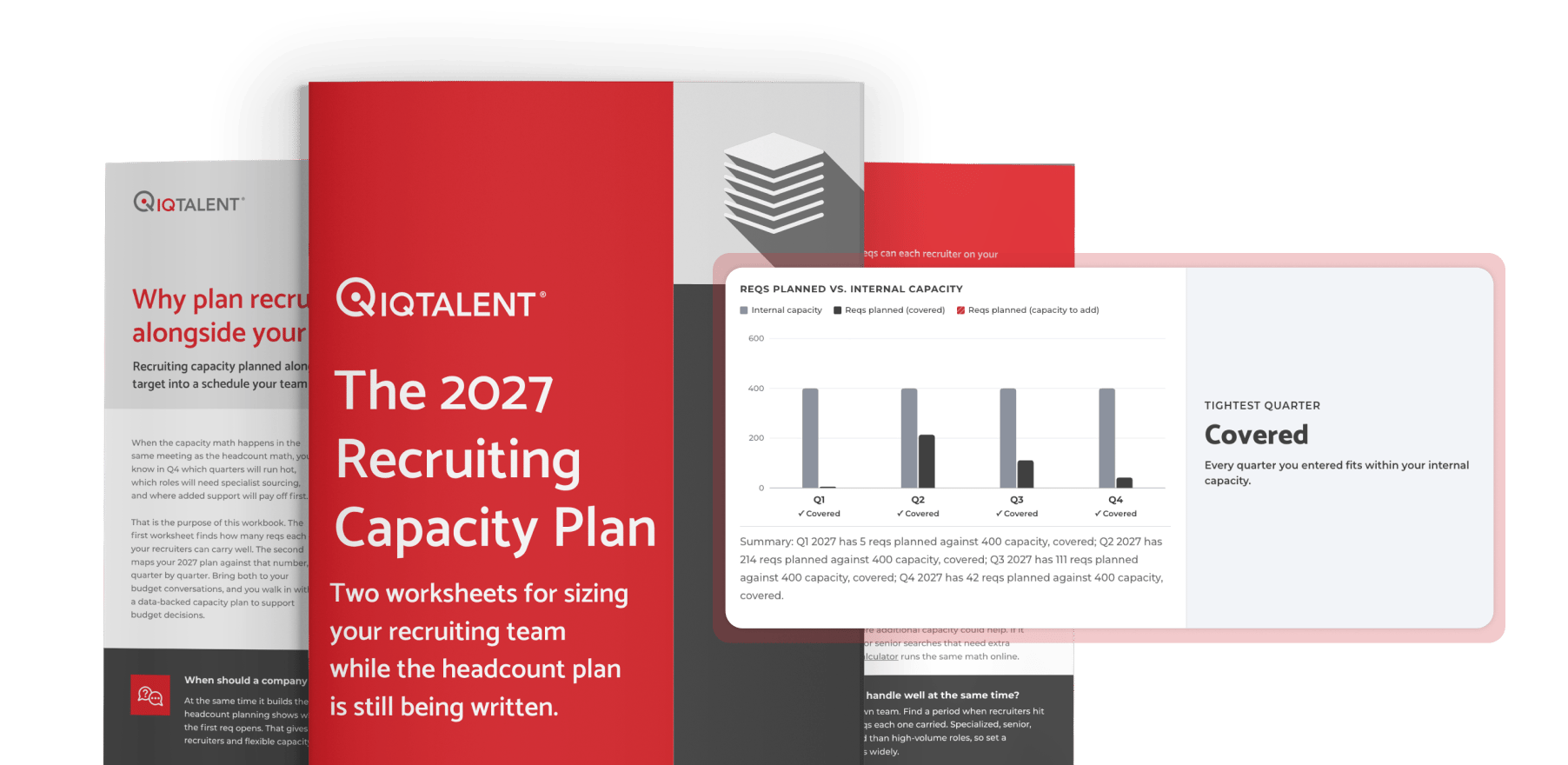
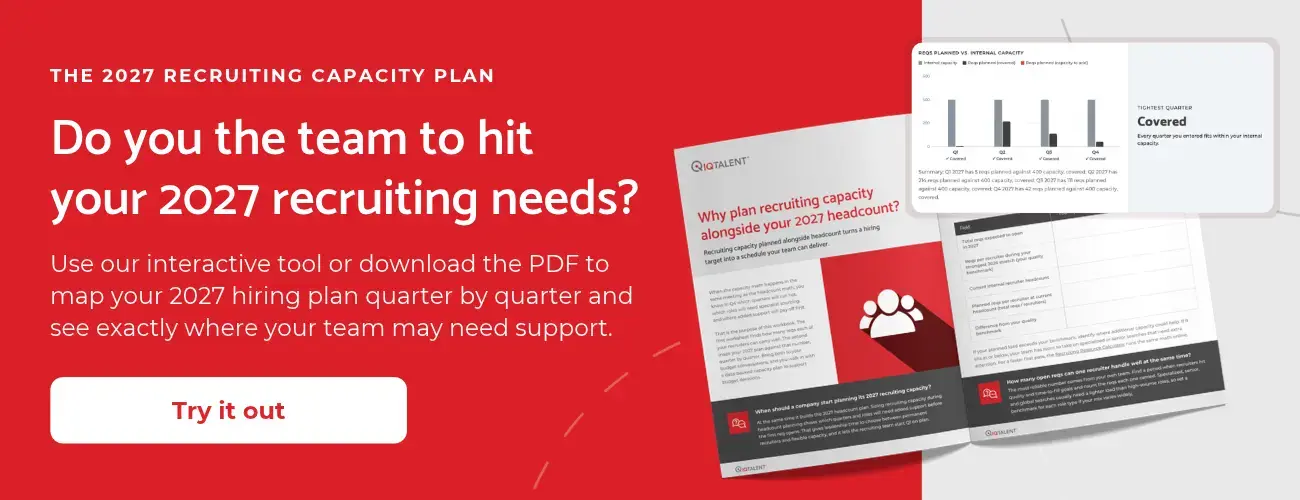
Our recruiting resource calculator gives you a starting number for that gap. Treat it as a first pass and check it against your own req history. If a spike is likely, keeping a recruiting bench ready costs less than starting cold in the quarter you need people.
How can team alignment and peer learning strengthen TA strategy?
Offsites and industry events give distributed talent teams time to align. Reviewing workflow bottlenecks, testing new platforms, and evaluating partnership models together builds stronger cohesion across remote recruiting teams. Meeting the IQTalent team at industry events also helps talent leaders benchmark their practices against peers and refine their capacity plans.
Q: Why is peer alignment critical for 2027 TA planning?
A: Distributed talent acquisition teams need structured time together to evaluate technology, review role family forecasts, and fix operational bottlenecks. Planning together keeps candidate engagement and recruiting operations consistent across locations, so the 2027 plan is executed the same way everywhere.
How can IQTalent help turn a 2027 plan into recruiting capacity?
If your hiring plan shows a gap between workload and internal capacity, the next step is mapping specific role families. IQTalent, Inc. recruiters work directly inside your ATS, so candidate data, pipeline history, and notes remain your property. Services like RPO and Candidate Sourcing adapt to your operating structure.
Q: How can IQTalent, Inc. help turn a 2027 hiring plan into scalable recruiting capacity?
A: IQTalent, Inc. embeds recruiters in your ATS to support specific role families through On-Demand Recruiting, Candidate Sourcing, or RPO. A 15 to 30 minute consultation aligns your role requirements with execution capacity, and your company keeps full ownership of its candidate data.
Book a 15 to 30 minute consultation to map your 2027 role list to recruiting capacity.
IQTalent, Inc. provides on-demand recruiting, candidate sourcing, and RPO services that work directly inside your ATS while keeping candidate data in your control.
Frequently Asked Questions
What are the latest trends in talent acquisition for 2027?
Three talent acquisition trends stand out for 2027: buyers arrive with defined hiring needs instead of broad questions, AI evaluation has moved from experimentation to fixing specific workflow steps, and senior leaders want flexible recruiting capacity that works inside their own ATS. IQTalent, Inc. saw these patterns across client conversations and at RecFest Nashville.
What is a talent acquisition strategy?
A talent acquisition strategy is the plan for which roles a company will hire, when, and how it will staff the work to fill them. Strong plans start with role families and start quarters rather than a raw headcount number. Budget, tools, and recruiting capacity follow from that role list.
How do you build a talent acquisition strategy for 2027?
Build it on four pillars: define key role families and map start dates by quarter, decide which process steps benefit from AI and which need human evaluation, give every operational change a single owner and deadline, and measure capacity gaps in role volume and timeline instead of headcount. This structure reflects the talent acquisition trends IQTalent, Inc. sees among senior TA leaders.
How should you use AI in talent acquisition?
Use AI where it changes a named step in the hiring process: sourcing, outreach, screening, scheduling, or reporting. Automation supports sourcing and operational work, while experienced recruiters make the selection decisions. Teams earlier in AI adoption can start by picking one step and fixing it.
How can a TA team add recruiting capacity without adding headcount?
Flexible models such as On-Demand Recruiting and Candidate Sourcing add recruiters who work inside the team's existing ATS and workflows. IQTalent, Inc. recruiters embed directly in the client's ATS, so candidate data, pipeline history, and notes stay with the company. This is one of the clearest talent acquisition trends among director-level TA leaders planning for 2027.