

A portfolio recruiting partner gives an operating partner something a vendor list cannot: one firm supplying recruiters and sourcers to every portfolio company that needs them, each company getting support sized to its own volume, and one view of how hiring is going across the group. When a value creation plan depends on filling growth and leadership seats inside the hold period, that view is the difference between seeing a slip coming and reading about it in a quarterly review. IQTalent's PE portfolio playbook covers the portfolio company side, and the private equity and portfolio companies page covers how the model works.
Most operating partners start from a preferred vendor list. The rates are negotiated and every CEO knows it exists. So ask a simple question: how many portfolio companies used the list this quarter, and what did each one get for it?
A PE fund's preferred vendor list sets a rate. A portfolio recruiting partner determines who actually does the work—and what the fund can see afterward.What does one recruiting partner give a portfolio that a vendor list does not?
One recruiting partner gives a fund the people who do the work, not just a rate. A preferred vendor list is a procurement instrument: it sets a rate and names the firms a portfolio company may call. It does not set who does the work, how quickly they start, or what the fund can see afterward.
Without that, each company solves recruiting its own way. The largest builds an internal team. The mid-sized companies use whichever agencies their last people leader trusted. The earliest-stage companies have a founder sending outreach at eleven at night. Each choice makes sense locally, and all of them hire into the same market: the Bureau of Labor Statistics JOLTS release for August 2026 (preliminary) shows 7.079 million U.S. job openings and a 3.3% hires rate.
Q: What does a portfolio recruiting partner do that a preferred vendor list does not? A: A portfolio recruiting partner supplies the people who do the recruiting, not just a rate card. IQTalent places named recruiters and sourcers inside each portfolio company's own ATS and interview process, sized to that company's volume. The fund gets one relationship and one view of how hiring is going across the group.
What does one recruiting partner across a portfolio look like in practice?
It is one relationship at the fund level. Each portfolio company gets named recruiters and sourcers who work inside its own systems, on demand or through a longer embedded engagement, at the volume it needs this quarter. Here is what the model has produced on real engagements
- A semiconductor company scaled from 20 hours per week to a nine-person embedded team and hired 60+ engineers in 90 days. The engagement continued for more than two years. Read the semiconductor case study.
- A Fortune 500 technology company hired 76 SDRs over three years through a group-interview model IQTalent designed and ran. Read the SDR case study.
- A cybersecurity company replaced a multi-agency recruiting stack with one embedded IQTalent recruiter and delivered 27 hires at a 30-day average time to fill.
- A parent company and its portfolio relied on centralized sourcing from IQTalent for more than ten years, and the work grew to include full-cycle recruiting support for five other large portfolio companies. Read the centralized sourcing case study.
IQTalent was named to the Hunt Scanlon Top 15 recruiting firms list in 2024. Support runs globally, across regions, which matters when one portfolio company is hiring in one market and another is standing up a team in a different region.
At Strategex, the work was a Private Equity Researcher and a Director of Business Development for the firm's private equity practice: the narrow, function-specific hiring a portfolio generates all the time and rarely has internal capacity for. Dedicated sourcing is built for exactly that.
"Emmalina and Joe are fabulous to work with. They are experts at their craft. Emmalina earned the confidence of our candidates, which allowed us to speak with highly qualified talent."
-- Sandy Nash, CFO and CHRO, Strategex
Q: Can one recruiting partner support portfolio companies of different sizes? A: Yes. IQTalent sizes support separately for each portfolio company, based on its stage, volume, and roles. Each company keeps its own ATS, interview loop, and hiring culture. When a company ramps, support ramps with it. When hiring slows, support comes down, and every candidate, note, and pipeline stays with the company.
Why do portfolios centralize recruiting last?
Recruiting stays local longest because hiring sits closer to a company's operating culture than almost any other back-office process. Many portfolios centralize finance systems, benefits brokerage, or security tooling first. Put a fifty-person company and a nine-hundred-person company on one rigid setup and you create friction at both ends.
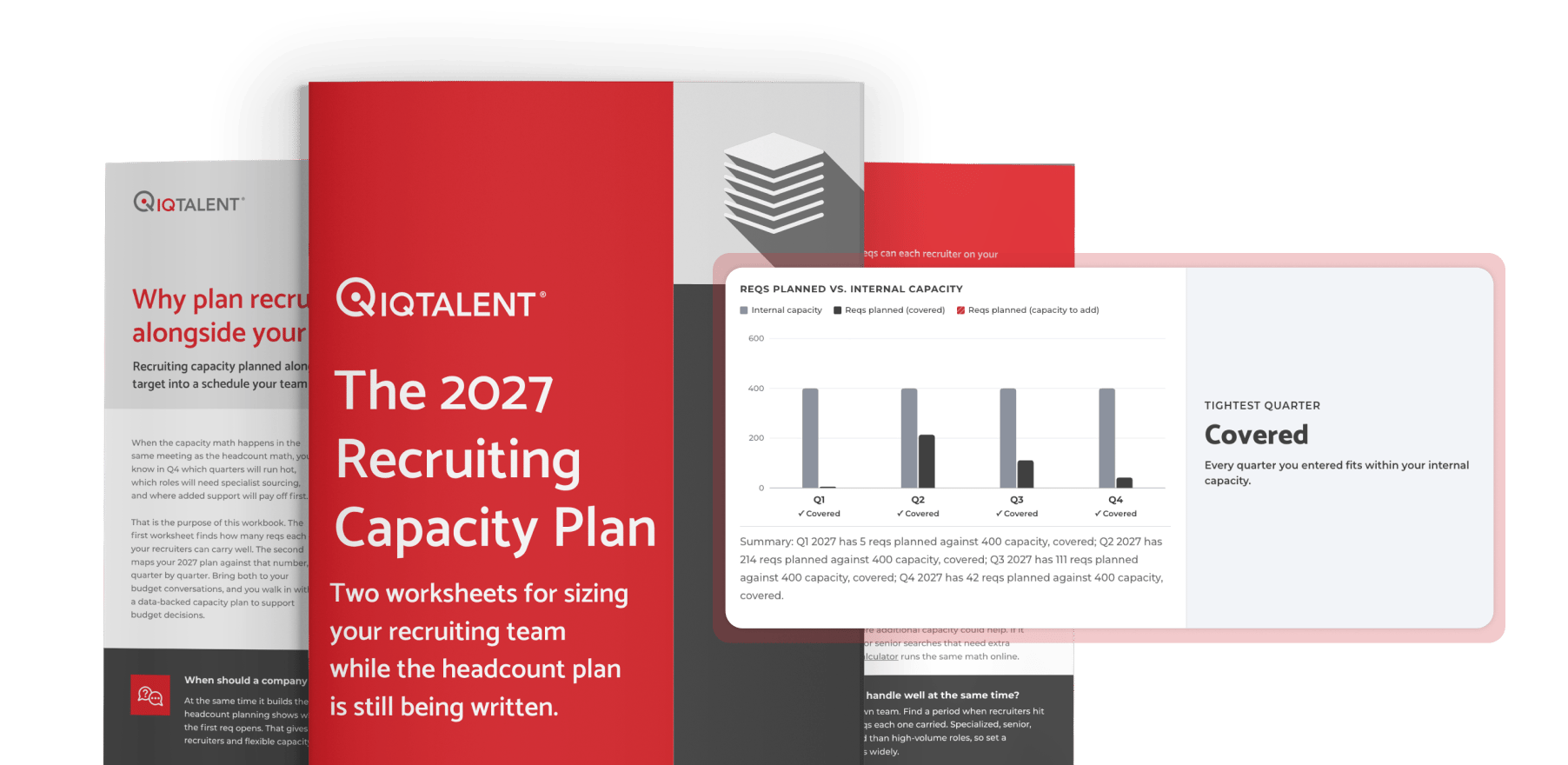
The choice looks binary: leave it alone, or centralize and break something. It is not. Standardize the bench, not the process. Keep the same recruiting partner, the same speed to start, and the same data ownership across the portfolio, while each company keeps its own ATS, interview loop, and hiring culture. A good first step is sizing each company's gap with the recruiter capacity calculator.
Q: Why is recruiting the function portfolios centralized last? A: Hiring sits close to a company's operating culture, so one rigid setup creates friction between a fifty-person company and a nine-hundred-person one. IQTalent's approach standardizes the bench instead of the process: the same recruiting partner, the same speed to start, and the same data ownership, while each company keeps its own ATS and interview loop.
Most PE portfolios centralize finance and security tooling before recruiting. Here's why that sequencing makes sense—and how to fix it without disrupting the companies.How do IQTalent and Caldwell cover a portfolio?
IQTalent covers professional hiring, from individual contributors through senior leaders, across engineering, go-to-market, finance, operations, and specialized technical roles, with global coverage, on a transparent, no-commission model. Caldwell, IQTalent's parent company, leads retained executive and board search: the work a portfolio generates when a new CEO, a first CFO, or a board build-out arrives.
Traditional retained search is critical for those high-stakes appointments. Together, IQTalent and Caldwell provide a full-spectrum recruiting solution inside one relationship, so the growth hiring inside a portfolio company and the executive search above it share one view of the same company. Everything built during an engagement stays with the portfolio company: candidates, pipelines, ATS improvements, and reporting.
Q: How does IQTalent support a private equity portfolio? A: IQTalent provides one recruiting relationship across a portfolio: named recruiters and sourcers embedded in each company, sized to its needs, on a transparent, no-commission model. Caldwell, IQTalent's parent company, leads retained executive and board search. Together they cover the full org chart under one relationship, and each company keeps everything built during the engagement.
What makes portfolio recruiting programs stick?
Programs stick when adoption is earned company by company rather than mandated from the fund. When a master agreement is pushed down from the top, some portfolio companies comply, some keep their existing relationships, and others use the new partner for roles they care least about. Portfolio company leaders read a mandated vendor as the fund solving a fund problem at their expense.
The rollout that holds starts with the two or three companies hiring hardest right now, where the need is clear and the CEO wants help. Results there travel to the rest of the portfolio on their own. Our strategic talent acquisition guide for private equity portfolios covers the planning side, and On-Demand Recruiting covers how support scales once it does.
Q: How should a fund roll out a shared recruiting partner across its portfolio? A: Start with the two or three portfolio companies hiring hardest right now, where the need is clear and the CEO wants help. Embed IQTalent there first. When those engagements produce results, other portfolio leaders ask for the same support on their own terms. Adoption that spreads sideways holds up better than adoption mandated from the fund.
What does a hard search look like from the Caldwell side?
Cait Houston, a Partner at Caldwell, described working with one of our sourcers on a highly specialized search. Her note was about mapping: he brought a disciplined approach to a narrow talent market and created clarity early, which made the rest of the search faster and more focused. That is the quiet value of dedicated sourcing. Someone knows the map before the search starts, so nobody spends six weeks learning the market is smaller than the plan assumed.
"Joe was a strong partner on this search, bringing a disciplined and comprehensive approach to mapping a highly specialized talent market. His work helped create clarity early and supported a more efficient and focused search process."
-- Cait Houston, Partner, Caldwell Partners
Send us the two or three portfolio companies hiring hardest right now, and we will tell you how we would staff each one. Book a 15 to 30-minute consultation.

Chris Murdock
Chris founded IQTalent in 2009 and has spent over two decades at the center of the recruiting and talent acquisition industry. He built IQTalent from the ground up in Nashville after years on the front lines of executive recruiting, working with Yahoo!’s internal executive recruiting team and earlier in his career with Heidrick & Struggles and TMP Worldwide in talent research and candidate sourcing. Connect on LinkedIn →
Frequently Asked Questions
What is a portfolio recruiting partner in private equity?
A portfolio recruiting partner is a single recruiting firm that supplies named recruiters and sourcers to every portfolio company in a PE fund's portfolio, with support sized to each company's volume and stage. Unlike a preferred vendor list—which sets a rate and names firms a portfolio company may call—a portfolio recruiting partner determines who does the work, how quickly they start, and provides the fund with one consolidated view of hiring across all portfolio companies.
How does on-demand recruiting work for PE portfolio companies?
On-demand recruiting places named recruiters and sourcers directly inside a portfolio company's existing ATS and interview process, at the volume that company needs in a given quarter. Support scales with hiring activity: when a company ramps, the team ramps with it; when hiring slows, support comes down. Everything built during the engagement—candidates, pipelines, ATS improvements, and reporting—stays with the portfolio company.
Why do PE portfolios typically centralize recruiting last?
Recruiting stays decentralized longer than other back-office functions because hiring sits close to each portfolio company's operating culture. Applying a single rigid setup to a 50-person company and a 900-person company simultaneously creates friction at both ends. The more effective approach is to standardize the recruiting partner—maintaining consistent speed to start, data ownership, and bench quality—while letting each company keep its own ATS, interview loop, and hiring culture.
How should a PE fund roll out a shared recruiting partner across its portfolio?
The rollouts that hold start with the two or three portfolio companies hiring hardest right now, where the need is clear and the CEO wants help. Once those engagements produce results, other portfolio company leaders typically request the same support on their own terms. Adoption that spreads laterally from peer to peer is more durable than adoption mandated from the fund level.
What is the difference between IQTalent and a traditional retained search firm for PE portfolios?
IQTalent covers professional hiring from individual contributors through senior leaders, across engineering, go-to-market, finance, and operations, on a transparent no-commission model. Caldwell, IQTalent's parent company, leads retained executive and board search for the high-stakes appointments a portfolio generates—new CEOs, first CFOs, and board build-outs. Together they provide full-spectrum coverage under one relationship, so growth hiring and executive search share one view of the same company.